
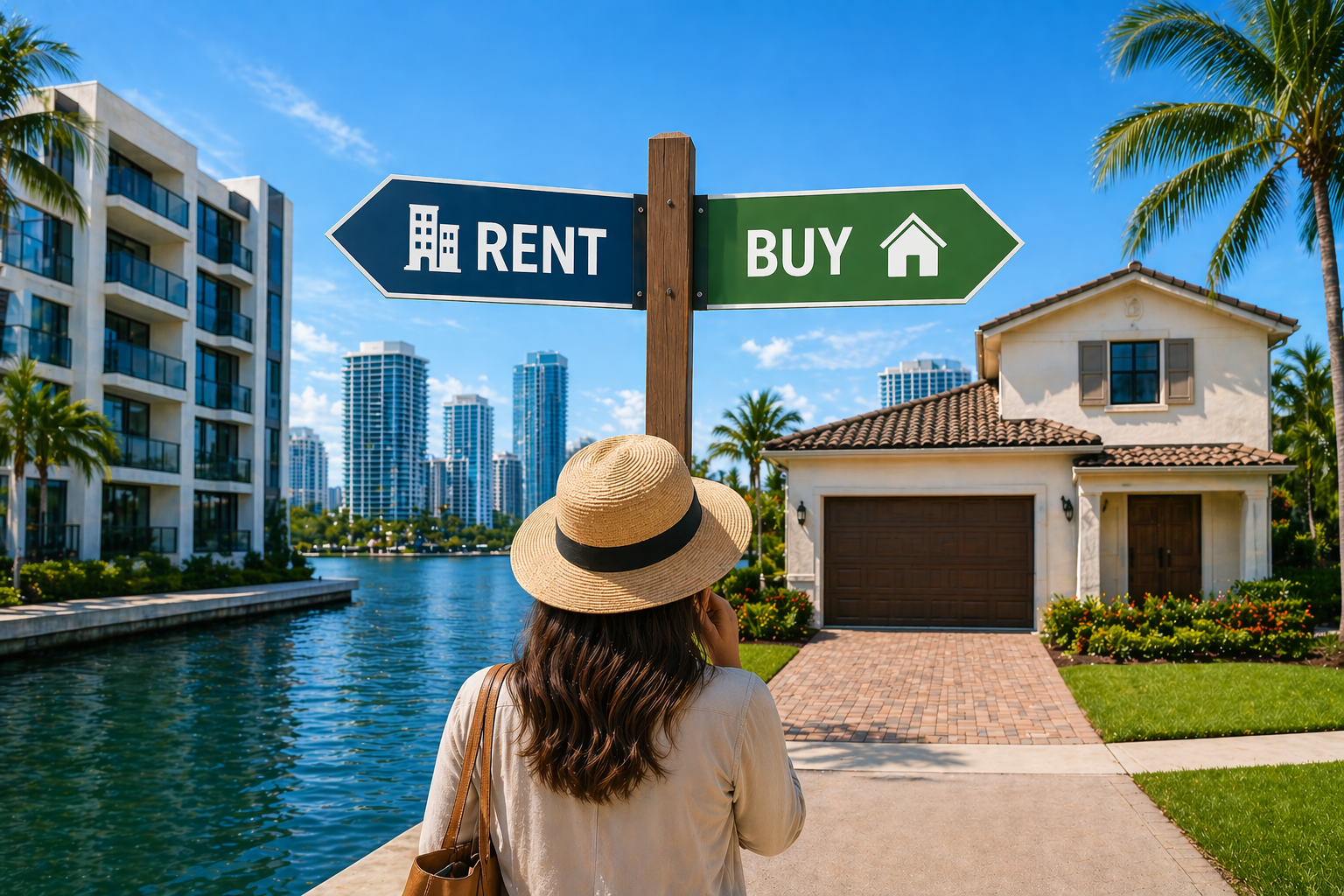
Welcome to the Sunshine State. If you’ve recently arrived in Miami, Fort Lauderdale, or West Palm Beach, you are probably already feeling the energy. There is ocean air, a diverse culture, lots to do, and a real estate market that moves quickly.
At The Homeowner’s Agent, we speak with new residents every day who ask the same important question. Does it make more sense to buy a home now, or is it better to rent and wait?
A few years ago, the answer depended on personal preference and timing. In 2024 and 2025, many people chose to rent first and watch the market. That approach made sense then. But as we move through 2026, the situation is changing. Prices, interest rates, and rental demand are shifting the balance.
So, let’s look at what works best for your life in South Florida: Renting vs. Buying a Home.
The 2026 Market Snapshot: Where Are We Now?
To understand the rent versus buy decision, you need a clear picture in 2026. We are no longer seeing the extreme price jumps from 2021, but the market has not crashed either. Instead, things have settled into a more balanced environment where buyers and renters both have options.
The Cost of Buying
As of mid-April 2026, the average 30-year fixed mortgage rate is around 6.37 percent. This is higher than the unusually low rates seen in the early 2020s, but it is lower than the peaks we saw about a year and a half ago. When interest rates drop it does create more affordability, but when interest rates continue to drop buyer demand increases which increases prices.
Another important shift is inventory. In the past few years, buyers have had very limited choices and faced intense competition. Now, more homes are available, which gives buyers more time to compare options and make informed decisions.
Here is a simple look at median home prices in key South Florida areas:
- The Miami median home price is around $625,000
- The Fort Lauderdale median home price is around $599,000
- The West Palm Beach median home price is around $369,000
The above numbers are based on single family homes, townhomes and condos. West Palm Beach appears more affordable mainly because condos and townhomes make up a larger share of the market there.
While buying still requires a down payment, closing costs, and ongoing maintenance, the improved inventory and stable rates are making homeownership more realistic for many new residents.
The Cost of Renting
Renting has not become significantly cheaper. In fact, rents have continued to rise, although at a slower and more predictable pace. On average, rental prices are increasing by about 4 percent to 7 percent each year.
Here is what renters are currently paying for a 3-bedroom home:
- Miami’s average rent ranges from about $3,000 to $6,000 per month
- Fort Lauderdale’s average rent ranges from about $3,000 to $5,000 per month
- West Palm Beach average rent ranges from about $3,000 to $5,000 per month
Of course these prices can increase quickly depending on property type, development, proximity to the water and amenities.
This steady increase in rent is an important factor. While renting still offers flexibility, the long-term cost can add up quickly, especially if rents continue to rise each year.
The Break-Even Point: The 3-Year Rule
When you move to a new state, flexibility matters a lot. If you are unsure about your commute, job stability, or the feel of a neighborhood, renting for the first year is often a smart and low-risk decision.
But the numbers in 2026 are telling a clearer story. If you plan to stay in one place for three years or more, buying a home usually becomes the better financial choice.
Why? Because the gap between renting and owning has narrowed. In many South Florida suburbs, the difference between a monthly rent and a mortgage payment is now only about $200 to $400. That difference looks small, and when you break it down further, it often disappears.
When you pay a mortgage, part of your monthly payment goes toward the principal. This builds equity, which is essentially your own savings. You may also benefit from mortgage interest tax deductions, depending on your financial situation. These factors reduce the real cost of owning.
The Hidden Math of Renting
Let’s look at a simple example.
If you rent a home for $3,000 a month in 2026, and your rent increases by a conservative 5% each year:
- In year one, you spend about $36,000 on rent
- By year five, your annual rent rises to around $43,750
- Over five years, you have spent more than $200,000 in total
This money is gone. It does not build any long-term value for you. Now compare that to buying a home for $500,000.
With just 2 percent annual appreciation, average appreciation in Florida is 3.5% – 3.8%, the home’s value increases steadily over time. At the same time, each mortgage payment reduces your loan balance. After five years, you could build between $100,000 and $140,000 in equity, depending on your loan terms and market conditions.
Insurance and Taxes
You can’t talk about Florida real estate without talking about the Homeowners Insurance and Property Taxes.
The Good News on Insurance
The insurance crisis of 2024–2025 has begun to cool. New carriers entered the Florida market in early 2026, creating much-needed competition. While rates aren’t cheap, they have stabilized.
The Pro Tip: When buying, look for homes built after 2010 or those with recent wind protection upgrades (impact windows and reinforced roof straps). Having full hurricane protection can definitely help to slash your insurance premium prices.
The Save Our Homes Advantage
Florida has a unique benefit called the Homestead Exemption. If you buy a home and make it your primary residence, the assessed value for property taxes cannot increase by more than 3% per year. Renters do not get this protection. When a landlord’s taxes go up, they simply pass that cost onto you in the form of a rent hike. As a buyer, you lock in your tax protection.
Checklist: Is Buying Right for You in 2026?
Still unsure which path to take? Ask yourself these simple questions to get clarity:
- Do you plan to stay for at least three to five years? If yes, buying usually makes more financial sense. If your plans are short-term, renting gives you flexibility.
- Do you have a down payment of at least 3.5% to 5%, having to put 20% down is a myth unless you were buying a condo that required a larger down payment. You will also need an additional 2% – 5% for closing costs. The great thing in a buyer’s market is many times we can negotiate a credit or a portion of the closing costs being paid by the seller. Many loan programs in 2026 are designed to help buyers get started with lower upfront costs.
- Are you okay with rental rules? If you feel restricted by rental rules like not being able to paint, renovate, or even own a pet freely, that frustration has value too. Owning a home gives you control over your space and lifestyle.
- Are you prepared for unexpected costs? When you rent, repairs are handled by the landlord. When you own those costs, they are your responsibility. It is smart to keep a home emergency fund of at least 1 percent of the property value each year.
Why The Homeowner’s Agent Recommends Buying Now?
South Florida has a unique advantage that supports long-term property value. The region is geographically limited. The Atlantic Ocean sits to the east and the Everglades to the west. This means there is only so much land available for development.
Because of this, demand continues to push upward over time. Even when the market slows down, property values tend to hold steady compared to other regions.
In 2026, the market will have settled after the rapid changes of the past few years. This creates a window of opportunity. Buyers today are entering a more stable market, before the next major growth cycle begins.
Buying now is not just about owning a home. It is about securing a place in a market with strong long-term potential and building equity over time.
Final Thoughts
Every situation is unique. A condo in Brickell has a different rent vs. buy equation than a single-family home in Boca Raton.
If you’re ready to see what your specific monthly payment would look like compared to your current rent, let’s chat. At The Homeowner’s Agent, the goal is not just to help you buy a house. It is to help you make a smart decision and build a life that fits your goals in South Florida.
Frequently Asked Questions
1. I keep hearing about the ‘3-Year Rule.’ Does that really apply in 2026?
Yes. It is even more relevant now. In 2026, stable mortgage rates and rising rents mean the break-even point comes sooner. In many South Florida areas, rent is close to mortgage costs, so you often start gaining financially after about 30 – 36 months of ownership.
2. Is the Florida insurance crisis actually over?
Not completely, but it has stabilized. More insurers have entered the market, which has reduced rapid price increases. Buyers can lower premiums by choosing homes with newer roofs and impact windows or full hurricane protection which includes the front door, garage door and any and all openings/windows being fully covered. These features improve safety and can reduce insurance costs by a significant percentage over time.
3. How much do I actually need for a down payment in South Florida?
You do not need 20 percent anymore unless you are buying a condo that requires a larger down payment. Many buyers use low down payment options like FHA or Conventional programs. In 2026, you can often buy with 3.5 to 5 percent down. On a $500,000 home, that means roughly $15,000 to $17,500 upfront, plus closing costs which can range between 2 to 5 percent. Many times in a buyer’s market, which 2026 is, these costs can be negotiated into the deal by the seller giving the buyer a credit.
4. What is ‘Portability,’ and why are people talking about it?
Portability is a Florida tax benefit for homeowners. It allows you to transfer your existing property tax savings to a new home when you move. This helps keep your taxes lower even after upgrading, making it a strong reason to buy and establish a primary residence early. Check your county property tax appraisers website to learn more.
5. If I buy a condo instead of a house, do the rules change?
Yes, slightly. Condos often include monthly association fees that cover maintenance and shared amenities. In 2026, it is important to review building reserves, condo documents, meeting minutes, financials, current budget, and inspection reports known as the Milestone Report and Structural Integrity Reserve Study, SIRS. This helps you avoid unexpected repair costs or special assessments that could increase your overall housing expenses.
6. Should I wait for prices to drop significantly?
Waiting for a major price drop in South Florida is risky. The region has a strong demand and limited land. A report released in April 2026 by Florida State University (FSU) DeVoe L. Moore Institute shows that Florida is in a shortage of approximately 120K units. Prices are still rising slowly each year. Delaying your purchase could mean paying more later, while also spending money on rent that does not build any long-term value.